
Veranda House
This project was conceived for an avid craftsman/maker in Swellendam, a town rich in Victorian architecture. Inspired by the client’s admiration for this style, we aimed to create a home that reflects his passion while accommodating a limited budget. Our approach centered on incremental growth, allowing the house to expand over time without appearing incomplete, in line with South Africa’s DIY culture.
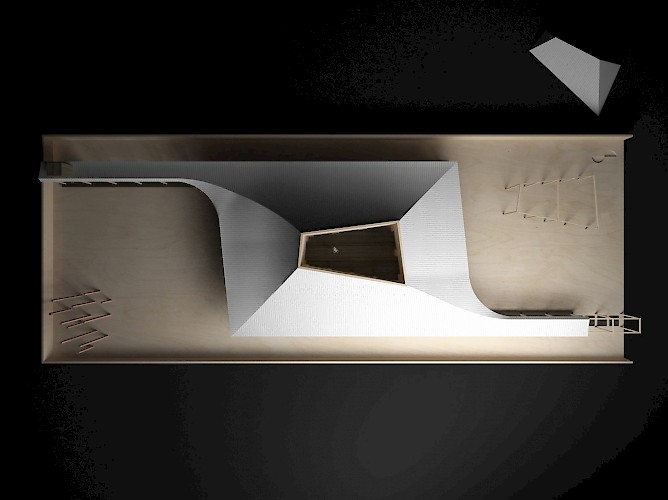
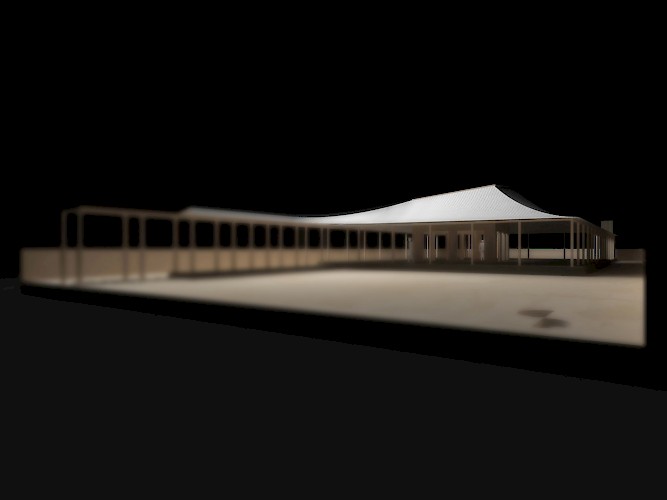
The design features an exceptionally wide veranda—a hallmark of Victorian and Cape Dutch architecture. Defined as an open-walled, roofed porch, the veranda serves as a multifunctional space for outdoor activities. We envisioned it as a protective environment that could be gradually populated with additional rooms as the client’s needs evolve, akin to oversized furniture on a plinth, where he could choose and create his own “filling.”
This approach not only embraces the incremental philosophy but also provides passive solar control, with the overhang effectively shading the building’s facades during the hot summer months.
Rather than fixating on every detail, we concentrated on the roof, a dominant feature of many buildings. Drawing from Victorian profiles, such as bullnose and concave designs, we discovered that certain roof shapes, crafted from corrugated sheeting, could be self-supporting, requiring minimal structural support apart from slender columns.
We found the concave profile most appealing due to its natural curvature, resembling a tent that gracefully conceals the roof's scale. This inspired us to explore whether we could extend this self-supporting concept to a larger scale. We developed an insulated sandwich panel consisting of corrugated galvanized sheets, with a pronounced corrugation where strips join, effectively forming a beam. This innovative design allows the roof space to be utilized as accommodation or storage above the living areas.
The project unfolds in a series of phases:
- Initial Construction: Begin with the roofed courtyard and build essential rooms.
- Adaptation: Remove the roof and relocate it over the garage, transitioning into the house while using the courtyard as a protected outdoor area.
- Expansion: Utilize the garage as a workshop to construct additional modules as required.
While still conceptual, this incremental approach has broader implications for affordable housing. It aligns with modular construction methods that are gaining traction, potentially offering scalable solutions for housing in the region.
Info
Date| Client| Design Architect| Location| Construction Cost| Gross Floor Area| Executive Architect| Structural Engineers| Services Engineer| | 2008 Confidential Steyn Studio Swellendam, ZA . xsqm TBC TBC TBC |